September 4, 2024Updated: June 29, 2026
Summarize with AI:



Nick Ceban
Managing Partner & Co-Founder, Royal Deck"Getting the board spacing right is essential to avoiding buckling, drainage issues, or a warranty claim down the road. The target gap for composite is 1/8 to 1/4 inch side-to-side, tight enough to be safe underfoot, wide enough to drain and let the deck breathe. One important factor we keep in mind is that a board installed during a cold 20-degree Illinois January is naturally more contracted than it would be in the summer heat, so we adjust the spacing to allow for that future expansion. Hidden fasteners take most of the guesswork out of it, but you still need to know the specs for the exact brand and board you're installing: Trex, TimberTech, and Deckorators each have their own tolerances."
When you are designing a new composite deck, one of the things that you must take into consideration is the amount of space that must be left between the boards. The gaps in your decking play a very important role. However, gaps that are too big or too small could cause a problem.
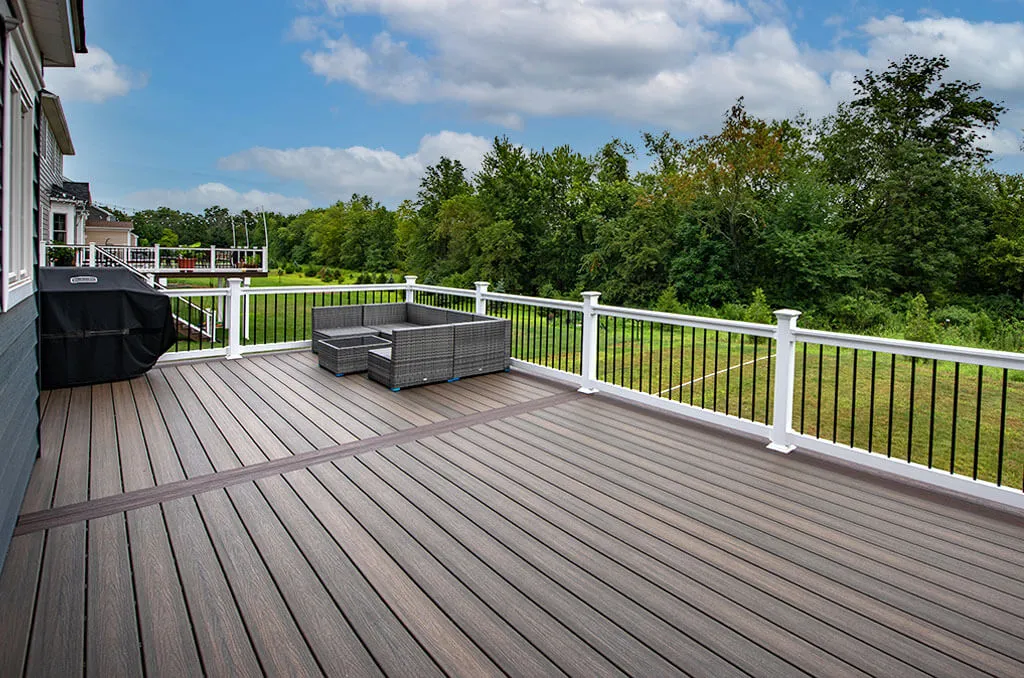
Why Do You Need Gaps In Your Deck?
There are three main reasons that you need to leave gaps in your deck.
- Expansion of deck material
- Drainage and drying
- Building codes
Expansion of Deck Material
Although composite material does not expand as much or as often as wood material, it still will expand when subjected to heat and cold. When you leave a gap between the boards on your deck, you are giving the material the room it needs to expand without damaging the boards. If the planks are right next to each other, they could become damaged over time or warp because they could not expand.
Drainage and Drying
Since your deck is outside, it is subjected to all types of weather. Rain, snow, and ice need somewhere to go once they reach your deck, and having a gap allows the water to drain and keeps your deck drier. Keeping the water from pooling on your deck can also help extend the life of the structure.
The gaps also allow the deck to dry faster underneath and allow the soil and ground area under your deck to “breathe” and remain dry. Soil that is kept too moist will become mildewed, and this can lead to “soft soil,” which can damage your deck and potentially the base of your house. Having the right size gaps in your deck allows this area to have air circulation and prevents these issues.
Building Codes
Every municipality has its requirements for deck construction, and they may have a specific measurement for the gaps in your deck. If this is the case, your deck builder will have to comply with the building codes.
Tips for Getting the Spacing Right
The most reliable way to maintain consistent gaps during installation is to use a spacing tool or dedicated composite deck fasteners. Many composite board systems include hidden fasteners that automatically set the correct gap as each board is secured, so you do not have to measure every single board by hand.
It is also important to account for the temperature on the day of installation. Composite boards contract in the cold and expand in the heat, so a board installed in winter will have slightly different spacing needs than one installed in summer. Your installer should adjust the gap width accordingly to ensure the finished deck performs correctly year-round.
How to Space Composite Deck Boards Correctly
Getting the spacing right from the start protects your deck from buckling, drainage issues, and potential warranty problems. Follow these steps during installation:
Step 1: Check Your Manufacturer’s Specifications
Before installation, review the guidelines for your specific brand. Trex, TimberTech, and Deckorators each have their own spacing tolerances, and the correct gap can vary from one product to another.
Step 2: Account for the Installation Temperature
Composite boards contract in cold weather and expand in heat. If you are installing in winter, leave a slightly wider gap to allow for summer expansion. If you are installing in summer, a tighter gap is appropriate. Adjust accordingly so the deck performs correctly year-round.
Step 3: Use Hidden Fasteners or a Spacing Tool
The most reliable way to maintain consistent gaps is to use dedicated composite deck fasteners or a spacing tool. Many composite board systems include hidden fasteners that automatically set the correct gap as each board is secured, removing the need to measure every board by hand.
Step 4: Target a Gap of 1/8 to 1/4 Inch Between Boards
Leave between 1/8 and 1/4 inch of space between boards side to side. This range is wide enough to allow for drainage and airflow underneath the deck, while staying tight enough to be safe underfoot. Gaps larger than 1/4 inch can create safety issues.
Step 5: Verify Compliance With Local Building Codes
Every municipality may have its own requirements for deck board spacing. Before finalizing your installation, confirm that your gap measurements meet local building codes. Your deck builder should be familiar with the requirements in your area.
The Actual Gap Width
The gaps between your boards will be between 1/8 and 1/4 inches in most cases. Composite decking can have smaller gaps because it does not expand as much as wood. Anything larger than a 1/4 inch gap could lead to safety issues.
For More Information About Composite Decking Contact Royal Deck
Royal Deck has been a leading custom composite deck builder serving homeowners across Illinois and Georgia for over a decade. If you are interested in building a beautiful outdoor entertainment area for your home, you can call Royal Deck for a quote.
Royal Deck will come to your home to take measurements and discuss with you the ideas you have for your deck area. We will then prepare a quote and give you an estimated start time for your project. Upon approval, we can begin construction as soon as you are ready.
If you have any type of questions about composite decking, please call Royal Deck today.
Frequently Asked Questions
 Is the gap between board ends the same as the gap between board sides?
No, these are two different measurements. The side-to-side gap between boards is typically 1/8 to 1/4 inch. The end-to-end gap at butt joints depends on the temperature at the time of installation. At temperatures above 40°F, a 1/8 inch end gap is standard, while colder conditions call for a slightly larger gap to account for greater contraction.
Do I need a gap where the deck meets a wall or post?
Yes, and this one is easy to overlook. Where your composite boards run up against a wall, post, or any solid structure, you should leave a gap of at least 1/4 inch. Without this space, the boards have nowhere to expand and can push against the structure over time, causing buckling or surface damage.
What happens if the gaps between my boards are too small?
Boards without enough room to expand can warp, buckle, or crack over time. Small gaps also restrict drainage, which can lead to moisture buildup underneath the deck surface. If your existing gaps are too tight, a professional can assess whether they can be corrected without replacing the boards.
Can debris get stuck in the gaps and cause problems?
Yes, leaves, dirt, and small debris can accumulate in the gaps over time. Keeping the gaps clear allows water to drain properly and prevents moisture from sitting on the surface. A regular rinse with a garden hose is usually all it takes to flush out any buildup.
How do builders keep spacing consistent across the whole deck?
Professional installers use spacing tools or specially designed fasteners that automatically set the correct gap as each board is placed. Consistent spacing makes a big difference in both the look and the long-term performance of your deck. Royal Deck handles all spacing calculations as part of our installation process so every board sits exactly where it should.

As a leading deck builder in Illinois and Georgia, Royal Deck specializes in creating stunning new decks, resurfacing existing ones, and designing porches that beautifully enhance homes.