February 25, 2026
Summarize with AI:


Introduction
Nearly 40% of homeowners replace their decks far earlier than expected, because materials that can’t handle weather stress and daily wear break down faster.
At Royal Deck, we work exclusively with composite decking from Trex, Timbertech, and Deckorators. After installing hundreds of decks, we’ve learned that deck material quality controls four outcomes: how many years you get before replacement, how long the appearance holds up, the safety of the deck, and how much you’ll spend over two decades.
By the end of this article, you will feel more prepared to understand why choosing the right materials protects both your investment and your loved ones.
The Lifespan Equation: How Quality Determines Longevity
How long does composite decking last compared to traditional wood? Real-world results from our projects tell a clear story.
The Science of Material Degradation
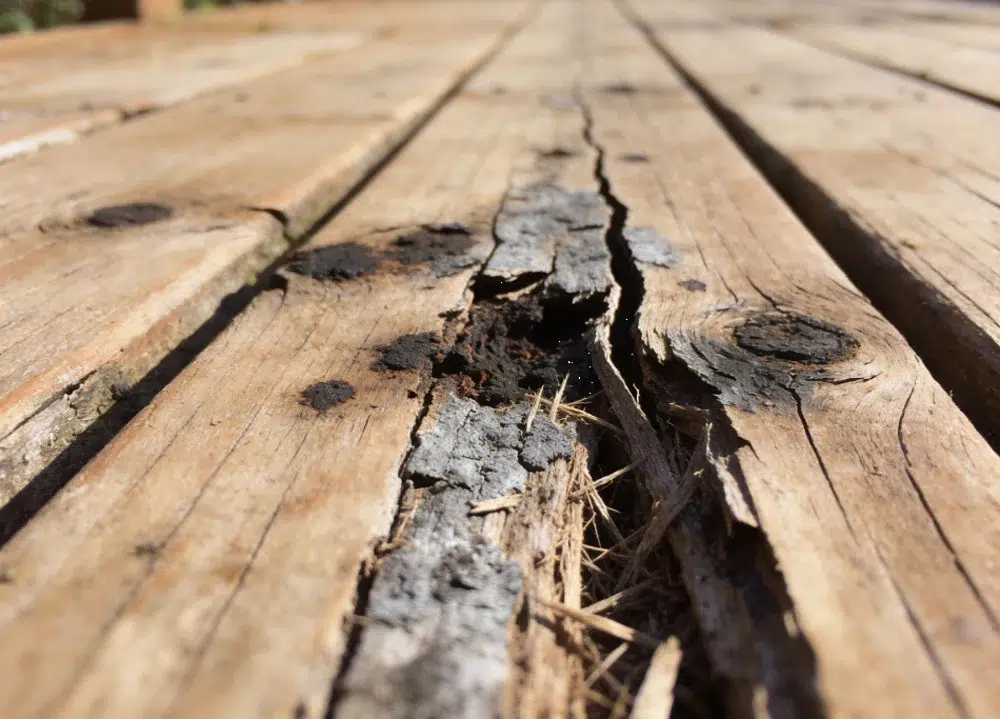 Degradation starts at the molecular level. Water penetrates porous surfaces, then expands and contracts as temperatures shift, building internal pressure. Which then results in cracking and warping. Low-quality materials soak up moisture and begin breaking down within a few years.
UV radiation attacks the molecules inside your wood and composite boards, making them brittle and causing the color to fade. Once you see these changes, they are a signal of a deeper structural problem. Better materials include UV stabilizers and protective cap layers that slow this process significantly.
Mold and fungus penetrate porous surfaces, speeding up decomposition and exposing you to health concerns. The longest-lasting deck material options feature engineered cores that block moisture and protective caps that shield against biological elements.
Real Timeline: Composite vs Wood Performance
Watch how the gap widens year after year.
| Timeframe | Traditional Wood Deck | Composite Deck |
|---|---|---|
| Year 1 | Fading starts, warping appears | Looks brand new, full strength |
| Year 3 | Splinters develop, rot spots emerge | Barely any surface change |
| Year 5 | Widespread rot, loose boards, safety concerns | Solid performance, minimal wear |
| Year 10 | Major structural issues, considering replacement | Still at 90%+ capacity |
| Year 15 | Replacement required for safety | Going strong, original appearance intact |
| Year 20+ | Already replaced once, maybe twice | Approaching the end of design life, still functional |
Why Regional Climate Matters
Illinois homeowners experience thirty to forty freeze-thaw cycles every year that put enormous stress on deck materials. Moisture trapped inside wood fibers expands during freezing, literally tearing boards apart from within. Traditional wood can’t handle this constant assault.
Georgia presents different but equally tough conditions. Summer humidity stays between 70 to 90% while UV exposure remains intense year-round. Mold thrives in these conditions. Surface integrity breaks down faster. Wood fails 40 to 60% faster in both environments compared to moderate climates.
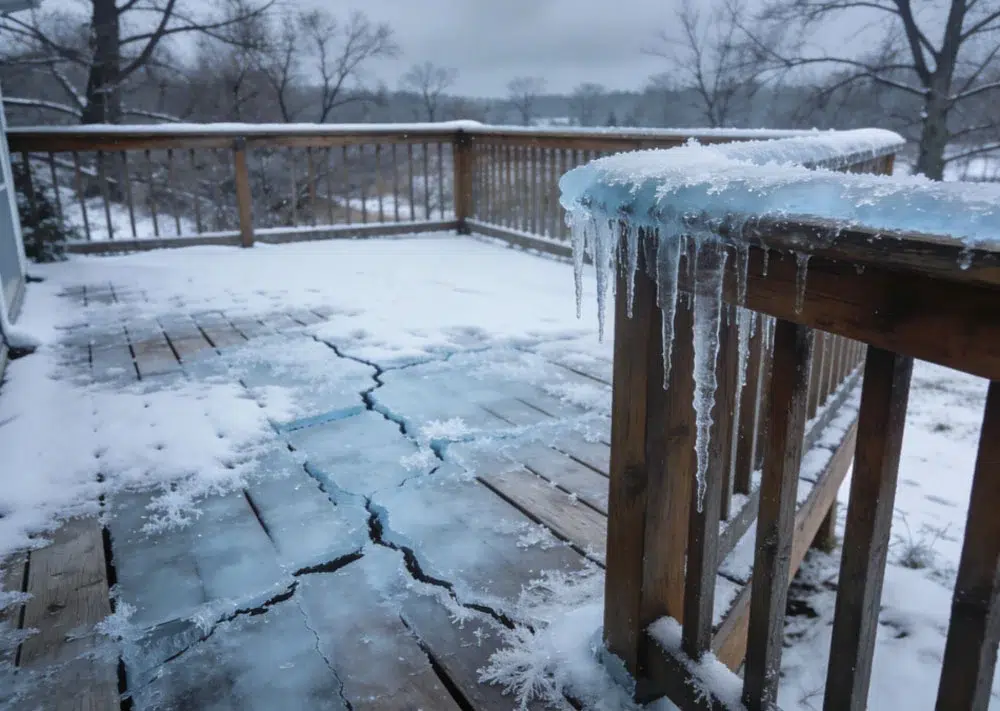 The durable deck material brands we install (Trex, Timbertech, Deckorators) are engineered specifically for these regional challenges. Composite decking durability in harsh climates is why our clients across both states choose these brands.
Why Royal Deck Specializes in Composite Materials
At Royal Deck, we work exclusively with composite decking from Trex, Timbertech, and Deckorators. Our focus on these three manufacturers comes from the simple principle that we install only what we’d put in our own homes. Explore our composite deck installations to see what that looks like in practice. These brands consistently deliver the performance, warranties, and customer satisfaction our Illinois and Georgia clients expect.
Quality composite delivers specific benefits:
- No rot or decay: Capped surfaces stop moisture penetration.
- Minimal maintenance: One annual power wash versus 40+ hours staining and sealing.
- Splinter-free for decades: Safe for bare feet throughout the service life.
- Color holds: UV-resistant protection maintains appearance while wood turns gray in months.
- Eco-friendly: Trex diverts 95% recycled content from landfills.
- No toxic chemicals: Unlike pressure-treated lumber.
Our Preferred Brands
Trex leads with industry-best warranties covering fade and stains for a quarter century. Trex decking maintenance means washing once a year. No staining. No sealing. Advanced capping delivers complete protection.
Timbertech brings scratch-resistant surfaces and wood grain textures that look remarkably realistic. Their engineering handles extreme weather exceptionally well.
Deckorators offers innovative colors and strong value for homeowners wanting top-tier performance without breaking the budget.
All three manufacturers stand behind their products with comprehensive warranties for materials that perform very well for over two decades.
Appearance Retention: Why Quality Materials Stay Beautiful
Choosing the best deck material for keeping your outdoor space looking great depends on how much time you want to spend maintaining it.
 The Maintenance Reality
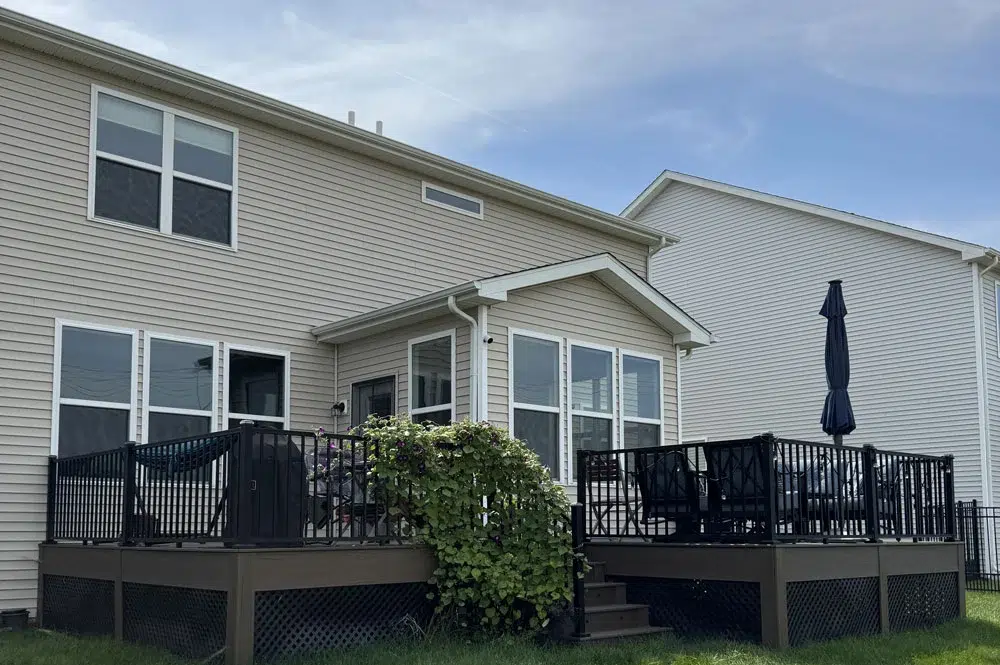 The Maintenance Reality
Traditional wood starts turning gray within 6 to 12 months. Reversing this aged look requires constant re-staining. Homeowners invest 40 hours annually, plus $500 to $800 in materials, maintaining appearance on a typical 12×12 deck.
Quality composite has fade-resistant compounds throughout the material and on the surface. The polymer caps shield the core of the board from UV penetration. The color remains stable for decades. Durability like Trex decking lifespan, combined with minimal upkeep deliver value for decades.
After 20 years, traditional wood may have required 800 hours of maintenance. As opposed to a composite that may rack up forty hours total. That’s 760 hours, or $8,000 to $12,000 saved over time at standard labor rates. The composite non-porous capped surface resists organic growth and wipes clean easily.
Impact on Home Value
Faded, deteriorating decks hurt curb appeal. Home values can drop 10 to 15% when buyers see broken-down outdoor spaces. For a $300,000 USD home, that represents $30,000 to $45,000 in perceived value lost with a worn out deck. Materials that maintain appearance throughout their service life can protect property values.
Safety Is Non-Negotiable
Material quality directly determines how long your deck remains safe and when it becomes a liability. This concern drives many of our clients’ decisions.
Structural Safety Risks With Wood
Traditional wood loses 30 to 50% of its load capacity within 10 years. Moisture causes internal rot. Deterioration happens inside boards before you see it on the surface. Decks look fine, but can’t support normal loads anymore. Dangerous situations develop during gatherings when multiple people concentrate weight in one area.
Fasteners pull out as the surrounding wood loses density. Railings and boards detach during normal use. Building codes require structural members to maintain specified load capacities throughout their service life. Degrading materials fail these standards.
Surface Hazards That Develop
Wood creates splintering risks for bare feet or animal paws as weathering wears surfaces down. Degraded boards become slick when wet after protective finishes wear away. Mold and mildew expose you to respiratory issues and allergic reactions. Sharp edges from cracking and splitting put you at risk of cuts and injuries.
Quality composite maintains smooth, splinter-free surfaces for its entire lifespan. Capped surfaces resist biological growth and maintain consistent traction. Composite decking does not rot under normal conditions. Its non-porous surfaces completely prevent moisture and biological infiltration.
The True Cost of Ownership: 20-Year Analysis
How long do decks last with different materials? This table reveals dramatic financial impacts.
| Expense Category | Traditional Wood | Composite Deck |
|---|---|---|
| Initial installation | $7,000 to 9,000 USD | $11,000 to 16,500 USD |
| Annual maintenance (materials) | $500 x 20 = $10,000 | $100 x 20 = $2,000 |
| Annual maintenance (labor/time) | 40 hrs x 20 = $8,000 value | 2 hrs x 20 = $400 value |
| Major repairs (years 8, 14) | $2,500 x 2 = $5,000 | $0 |
| Replacement (year 17) | $9,000 | Not needed |
| TOTAL 20-YEAR COST | $39,000 USD | $18,500 USD |
| SAVINGS WITH COMPOSITE | — | $20,500 USD |
What can be seen as a $4,000 to 7,500 initial savings from choosing wood could become $20,500 in net losses over two decades, or an unplanned need for deck resurfacing long before the material’s design life ends.
Break-Even and Long-Term Value
Break-even around year 7 to 9 with quality composite when cumulative maintenance and repair costs overcome the initial price difference. Beyond that point, you’re saving money continuously. After year 20, the advantage only grows as the composite keeps performing while the wood needs complete replacement.
Composite decks boost home value 5 to 8% at resale. Fixed costs like permits ($100-$500) and inspections ($75-$150) apply regardless of material choice. These deliver far better value when invested in installations lasting over two decades.
The opportunity cost of maintenance time has real value, too. Those potential 760 hours saved could go toward income-producing activities or family time. Stress from dealing with constant failures affects quality of life beyond financial calculation.
What Defines Quality in Composite Decking
Quality composite decking comes down to engineering, materials, and manufacturer commitment. Understanding these factors helps homeowners recognize why decking material options from Trex, Timbertech, and Deckorators deliver superior long-term value.
Royal Deck installs only materials meeting rigorous standards:
- Full capping protection: 360-degree polymer shell completely encases core material, preventing moisture intrusion from any angle.
- High density and weight: More raw material and fewer fillers create stronger, more durable boards that resist warping.
- Extended warranties: Coverage for over two decades demonstrates manufacturer confidence in real-world performance.
- Recycled content: Quality brands like Trex achieve 95% recycled materials without compromising structural integrity.
- Embedded UV stabilizers: Fade resistance throughout the material, not just surface coatings that wear away.
How These Factors Impact Performance
Capping technology separates premium composite from basic options. The polymer shell acts as a barrier against moisture, UV radiation, and biological agents. Without complete encapsulation, core materials remain vulnerable to the same degradation that destroys wood.
Material density affects both strength and longevity. Heavier boards contain more raw material and maintain structural integrity under thermal stress. Lighter options with excessive fillers warp and crack as temperatures cycle through seasons.
Warranty length reveals manufacturer confidence. Brands backing their products for a quarter century have extensive testing and real-world data supporting durability claims. These warranties are commitments based on engineering.
Deck Durability Verdict: Composite Over Wood Every Time
Material quality controls your deck’s lifespan, appearance, safety, and true cost over decades. Premium composite decking outperforms traditional wood through moisture resistance, UV protection, and structural stability.
At Royal Deck, we work exclusively with Trex, Timbertech, and Deckorators composite because these materials deliver over a quarter century of service with minimal maintenance. Our installations across Illinois and Georgia prove composite pays for itself within 7 to 9 years while providing superior performance throughout its design life.
Quality materials boost your home’s value, protect your family through maintained structural integrity, and eliminate the constant maintenance burden wood demands.
If you are ready to bring that vision to life with materials engineered for decades of durability, our Illinois and Georgia teams will design and build a composite deck or a covered porch that stands the test of time. Schedule your free in-home composite deck consultation today by calling Royal Deck.
Sources
- IRC R507.3 Deck Ledger Connection – Load capacity & attachment standards for material durability
- AWC DCA 6 – Wood deck decay protection & replacement timelines
- NADRA Deck Inspection Checklist – Structural failure analysis (load loss, rot)
- USDA FPL Wood Durability Research – Moisture, UV & biological degradation rates
Frequently Asked Questions
 How long should a quality composite deck last in Illinois or Georgia?
Expect over a quarter century with minimal maintenance. We install materials from Trex, Timbertech, and Deckorators engineered for regional climate stress: freeze-thaw cycles up north and humidity plus UV exposure down south. Traditional pressure-treated wood typically needs replacement after 10 to 15 years because moisture and temperature cycling speed up failure.
Is composite decking worth the higher initial cost?Yes. A 12x12 composite deck from Royal Deck runs around $16,500 USD initially with minimal ongoing expenses totaling roughly $18,500 over 20 years. Traditional wood costs $10,000 up front but $39,000 total over two decades due to constant restaining, repairs, and premature replacement. That's $20,500 in direct savings plus better home resale value and zero splinter hazards for your family.
Why does Royal Deck specialize in composite instead of wood?At Royal Deck, we've always focused exclusively on composite materials. Our specialization allows us to master installation techniques and deliver expertise that generalist contractors can't match. Composite delivers over two decades of service with virtually no maintenance, while wood requires constant upkeep and replacement within 10 to 15 years. Our clients appreciate that Trex decking maintenance means washing once annually: no staining, sealing, or structural repairs. We focus on these materials because they provide superior value, safety, and peace of mind.
What makes Trex, Timbertech, and Deckorators different from cheaper composite?Top manufacturers invest in full-cap protection, superior UV stabilizers, and rigorous testing for extreme conditions. Budget composite lacks proper capping and uses more filler materials that compromise durability. Warranties covering over two decades reflect engineering confidence backed by real-world performance. Budget brands typically offer minimal coverage because they expect failures. At Royal Deck we stake our reputation on materials that perform as promised.

As a leading deck builder in Illinois and Georgia, Royal Deck specializes in creating stunning new decks, resurfacing existing ones, and designing porches that beautifully enhance homes.