September 4, 2024Updated: July 22, 2026
Summarize with AI:



Nick Ceban
Managing Partner & Co-Founder, Royal Deck"Ninety percent of the deck failures we get called out to inspect share one thing in common. The homeowner never looked underneath. A deck can wear a flawless composite surface for years while a corroded joist hanger or an undersized footing quietly loses its grip below. That is not a maintenance issue we discovered by accident; it is the reason we tell every Illinois and Georgia client to get under their deck at least once a year with nothing more than a flashlight and a screwdriver. Catching a soft post or a rusted connector in April costs you almost nothing. Ignoring it costs you the whole structure."
Most deck failures do not happen out of nowhere. That collapse you read about in the news, the one where the railing gave way during a cookout, or the boards buckled under a crowd, almost always traces back to damage that was sitting there, quietly getting worse, for two or three seasons before anyone noticed. The Consumer Product Safety Commission puts the number of deck-related injuries in the United States at over 2,900 per year, and the bulk of those incidents involve structures that looked fine from the top.
If you own a composite deck in Illinois or Georgia, the stakes are specific. Illinois winters put ground-level footings through a freeze-thaw cycle that can shift concrete several inches over a few years. Georgia’s summer humidity keeps framing cavities wet long after the rain stops. Neither condition is visible from the deck surface, which is exactly why a structured deck inspection once a year is not optional maintenance; it is the only way to stay ahead of problems that cost far more to fix after they escalate. Think of it the same way you think about safety deck protocols for any load-bearing structure: the time to find the problem is before it becomes a failure.
Why Annual Deck Safety Inspections Matter
There is an easy way to understand why deck inspections matter so much: your deck is the only major structure on your property with no insulation, no interior wall cavity, and no protection from what the weather throws at it. The framing sits open to rain, temperature swings, insects, and in Illinois, road salt that migrates off boots and furniture all winter long.
At Royal Deck, we build composite decks that resist rot and insects by design, but even composite decks require annual structural review, because every deck is only as reliable as its framing, footings, and hardware. A Trex or TimberTech board does not rot, but the joist hanger it rests on will rust, and the concrete footing below the support post will eventually crack if it was not poured deep enough. A solid deck maintenance checklist run each spring catches those issues at the point where they are still inexpensive to address.
The right timing is spring after the frost in Illinois has finished its cycle and before the first wave of warm-weather use in Georgia. For decks over ten years old, add a fall walkthrough. That is the practical minimum, and it costs nothing but 45 minutes and a flashlight.
The Complete Deck Safety Checklist
A thorough deck inspection checklist does not require specialized knowledge; what it requires is a sequence. Start from the ground and work up: footings, then posts, then framing, then surface, then railings, then stairs. Problems originate at the bottom and show up at the top, so inspecting in reverse order means you will often miss what actually matters.
1. Foundation and Support Posts
Concrete footings have one job: hold the post load without moving. When they fail at that job because they were poured too shallow, or because the soil shifted after years of freeze-thaw cycles, everything above them is compromised. In Illinois, the IRC requires footings to extend at least 42 inches below grade. A footing poured at 24 inches will heave. It is not a question of if, but when.
Walk the perimeter and look at each footing pad. Hairline surface cracks are normal; cracks running vertically through the pad, or any visible tilt in the footing relative to the post, warrant a closer look by someone qualified to assess bearing capacity.
Deck post checking follows immediately. Press against the base of each post with your palm. Solid wood does not flex. If there is any give, press a screwdriver tip into the wood at ground level. Healthy wood pushes back; rotted wood accepts the tip with almost no resistance. Per the IRC, posts must clear the soil surface by at least 6 inches, and any post that sits directly on grade is already in trouble.
Check for:
- Vertical cracks or visible tilt in concrete footings
- Posts within 6 inches of the soil surface
- Soft or discolored wood at post bases
- Missing or corroded hardware at post-to-beam connections
2. Ledger Board and House Attachment
The ledger board is the single point of connection between your deck and your house, and it is responsible for more sudden structural failures than any other component. When a ledger pulls away from the house framing, the entire deck goes with it, not gradually, but all at once.
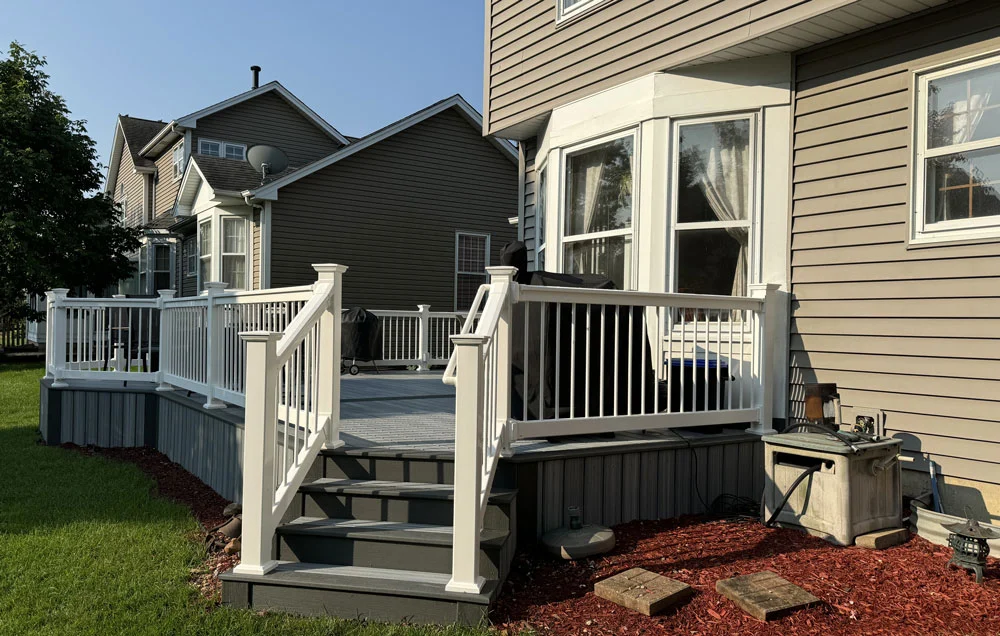 A correctly installed ledger has three things going for it: continuous metal flashing that channels water away from the house framing behind it, structural lag screws or through-bolts at the correct spacing, and no siding material sandwiched between the ledger face and the band joist. The flashing is the piece most commonly skipped on older and DIY-built decks, which is why water damage at the ledger is so common across both Georgia and Illinois climates.
Get under the deck with a flashlight and look along the top of the ledger. Orange or brown rust streaks running down from the lag screw locations mean the fasteners are corroding. A visible gap between the ledger face and the house framing, even a quarter inch, means the connection has already started to fail.
Check for:
- Flashing that is bent, missing, or separated from the house
- Rust streaking below any lag screw location
- Visible gap between the ledger and house framing
- Siding installed directly behind the ledger rather than removed and flashed
3. Joists, Joist Hangers, and Framing
Joists carry every pound of load placed on the deck surface, and the metal joist hangers that hold them in position do enormous work for their size. A hanger missing two of its eight fastener holes is not slightly weaker; it is operating well outside its rated load capacity.
Georgia’s combination of heat and humidity is particularly hard on framing cavities. Moisture that enters through gaps in the decking surface does not evaporate quickly in that climate, and joist ends where the grain is exposed inside the hanger deteriorate faster than anywhere else in the frame. When you inspect the deck from below, run your flashlight along the full joist span and look for any deflection in the line. A bow downward in the middle of a joist span is a structural finding, not a cosmetic one.
Check for:
- Rust on joist hangers, especially at the nail holes
- Missing fasteners in any joist hanger
- Soft or darkened wood at joist ends
- Any visible sag or deflection along joist spans
4. Deck Surface and Fasteners
Composite decking is one of the more meaningful advances in deck safety over the past two decades. Boards from Trex, TimberTech, and Deckorators do not splinter, do not require annual sealing, and do not produce the gray, weathered surface that pressure-treated wood develops within a couple of seasons. But composite boards do communicate problems when they have them, and the signs are worth knowing.
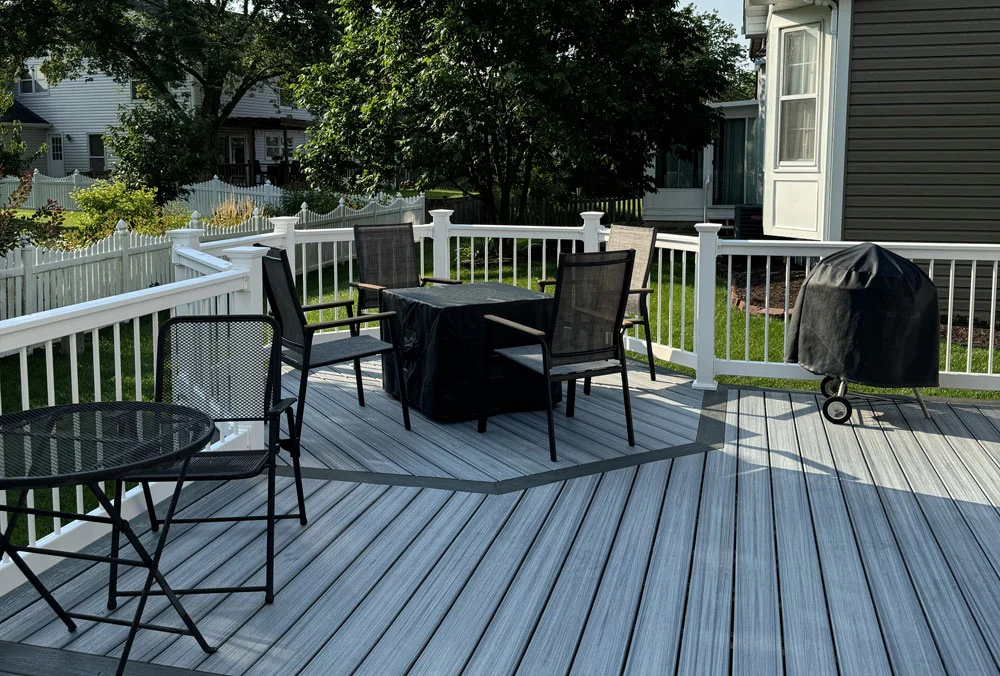 White or chalky mineral deposits on the board surface indicate moisture is getting into the board’s core, usually through a compromised factory cap layer. Edge delamination, where the top layer separates from the core along the board’s length, is another replacement indicator. On face-screwed composite installations, check for fasteners that have backed out and now sit proud of the board surface. Those raised edges catch shoes and toes in exactly the wrong way.
Walk every square foot of the surface slowly. Pay attention to boards that feel softer underfoot than the ones next to them, or that produce a hollow sound when tapped. Those are the boards worth flagging.
Check for:
- White mineral deposits or chalky film on composite board surfaces
- Edge delamination along the long sides of any board
- Fasteners sitting above the board surface
- Boards with noticeably more flex or a hollow sound when tapped
5. Railings and Balusters
Keeping a safe deck means treating railings as the life-safety components they are, not as aesthetic features. The IRC sets a minimum railing height of 36 inches for decks elevated 30 inches or more above grade, with many jurisdictions now requiring 42 inches for higher decks. Those numbers exist because a person leaning against a railing that is too short goes over it, not through it.
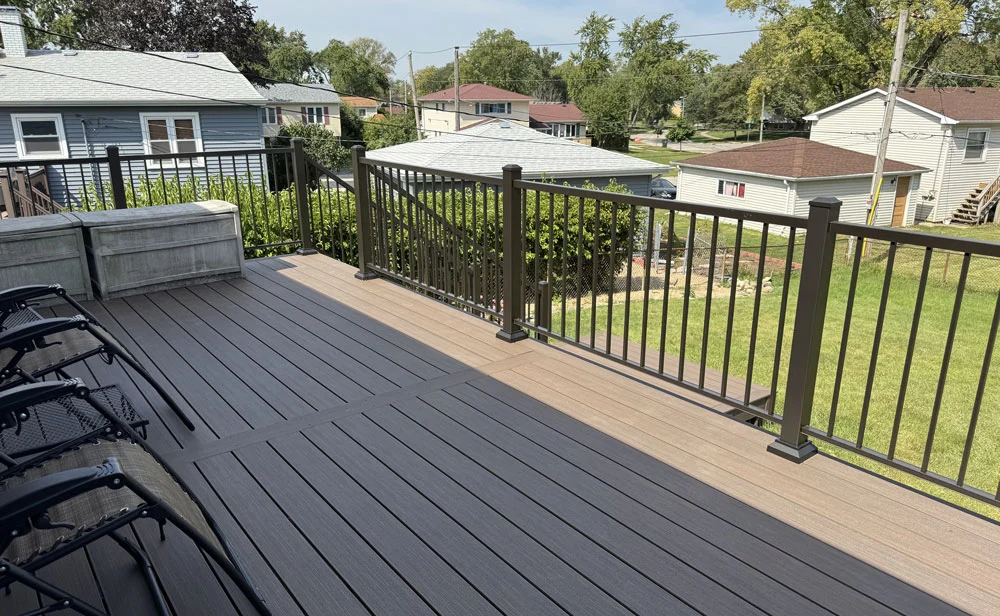 The 200-pound lateral force test is the practical standard for railing posts: push hard against the top of each post horizontally. Any movement at the base means the connection to the framing has loosened, and the deck should not be used until it is corrected. On composite railing systems, check the post base collar where the post meets the deck surface; that connection takes the most stress and is the first place corrosion shows up. If your current railings are showing their age, it’s worth reviewing some of the best deck railings options available today before deciding whether a repair or a full swap makes more sense.
Baluster spacing must not exceed 4 inches at any opening. Measure with a tape, not your hand. That dimension was set specifically to prevent a small child’s head from passing through, and it is one of the most commonly violated dimensions on decks built before 2000.
Check for:
- Any movement at the railing post bases under lateral pressure
- Baluster spacing exceeding 4 inches
- Corroded or cracked composite post base collars
- The top rail height is below the minimum for your deck’s elevation
- Missing or stripped fasteners at baluster connections
6. Stairs and Stair Stringers
Falls on deck stairs are the most common source of deck-related injuries, and the geometry of the stairs is usually a contributing factor. The IRC allows a maximum riser height of 7-3/4 inches and requires a minimum tread depth of 10 inches. When those dimensions are off even by half an inch, the inconsistency is enough to cause a misstep, particularly for older users navigating the stairs in low light.
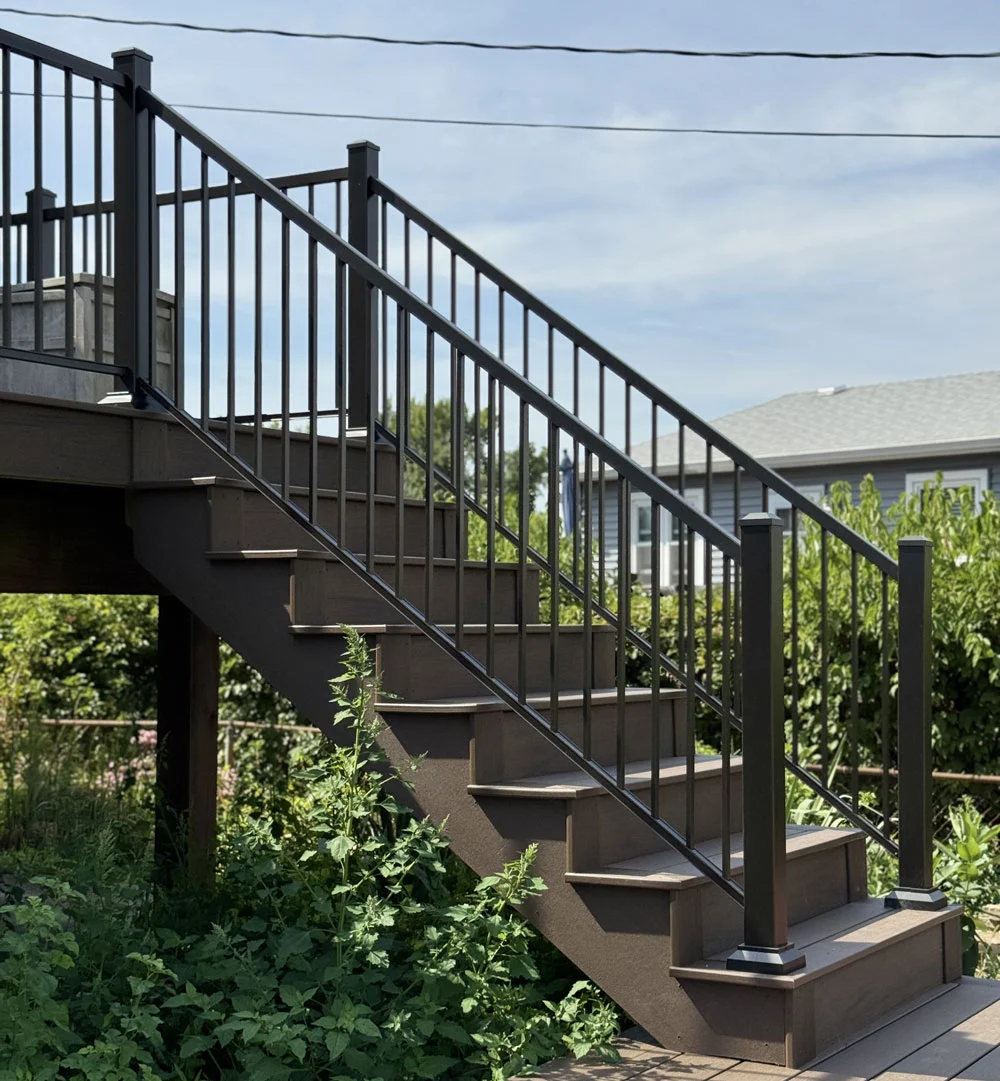 Stair stringers are the angled boards that bear the full load of the stair system, and they fail at the notches, the cutouts that create each tread landing. The notch reduces the stringer cross-section to its thinnest point right where bending stress is highest, which is why a crack at a notch is a serious finding. In Georgia, shaded stair treads develop algae and moss that turn slippery after rain; treating them with a composite-safe cleaner each spring and applying non-slip strips is straightforward prevention.
Check for:
- Riser height over 7-3/4 inches or tread depth under 10 inches
- Cracks running from any stringer notch
- Loose handrail connections at newel posts
- Slippery surface buildup on treads
Pest and Environmental Damage
Two of the most damaging forces working on any deck in the Southeast and Midwest are largely invisible until the damage is well established, which is why addressing safety deck concerns from a pest and environmental standpoint deserves its own category, not just a line in the structural checklist.
Georgia sits inside one of the highest subterranean termite pressure zones in the country, with an active season running from March through November. These insects target framing members and ledger boards, specifically the structural elements buried behind composite boards, where they are hardest to see. The test is simple: knock firmly on suspected framing members with a hammer. Dense, healthy wood returns a sharp sound; termite-damaged wood sounds hollow and dull. Look also for frass near post bases and stringer attachment points, the fine, sand-like debris that indicates active tunneling.
Mold on composite surfaces is almost always cosmetic. A light green cast in a shaded corner scrubs off with a composite deck cleaner and a stiff brush. The situation is different on framing members, where black or white fuzzy growth signals moisture sitting in the cavity long enough to feed fungal development, a problem that requires correcting the moisture source, not just cleaning the visible growth.
Illinois homeowners face a different threat: winter de-icing chemicals. Calcium chloride and sodium chloride products migrate onto deck surfaces through foot traffic, and both compounds accelerate corrosion in joist hangers and post bases significantly faster than moisture alone. Spring inspection in Illinois should always include a close look at every metal connector.
Composite decking from Trex and TimberTech resists insects and moisture by design, which is why Royal Deck recommends composite for Georgia’s humid climate. The boards hold up; the framing beneath them is where the attention needs to go.
When to Call a Professional
Some findings from a homeowner walkthrough call for a professional deck inspection before the deck sees another season of use. Knowing where that line is matters because qualified deck inspectors catch failure points that are genuinely difficult to evaluate without experience and the right tools.
Contact a deck inspector if you find any of the following:
- The deck surface moves or deflects when you walk across it, particularly near the ledger
- You can see a visible gap between the ledger board and the house framing
- More than one or two joist hangers show active rust or deformation
- Any framing member or stair stringer shows visible sag
- The deck sustained storm damage. Wind events in Georgia during hurricane season can compromise connections that look intact from above
- The deck produces cracking or popping sounds under normal loading
At Royal Deck, our Illinois and Georgia teams offer free in-home consultations. We assess your deck’s condition in person and give you a clear picture of where things stand, including whether a full composite deck replacement is the right next step.
Inspect Now, Enjoy Your Deck for Decades
A composite deck built to current code and inspected annually will outlast almost anything else on your property but that longevity depends on treating each yearly walkthrough as the real structural review it is, not a casual glance at the boards from above. The checklist above gives Illinois and Georgia homeowners the sequence and the specific details that actually matter. Royal Deck’s Illinois and Georgia teams are ready to help. Call us for a free in-home composite deck consultation today.
Sources
- CPSC – Deck, Porch and Balcony Structural Failures Data — Injury statistics and incident reports related to residential deck collapses, railing failures and structural deterioration across the United States
- NADRA – Check Your Deck® Consumer Inspection Checklist — 10-point homeowner inspection guide covering ledger boards, support posts, joists, fasteners, railings and stairs, published annually for Deck Safety Month
- IRC R507 – Exterior Deck Construction Requirements — Ledger attachment specifications, footing depth standards, railing load minimums, stair riser and tread dimensions, and baluster spacing requirements for residential decks
- AWC DCA 6 – Prescriptive Residential Wood Deck Construction Guide — Substructure framing standards, joist hanger fastener requirements and guard post attachment details applicable to composite deck substructures
- Trex – Composite Decking Product Warranty & Care Guide — 25-year warranty terms, surface care requirements, approved cleaning methods and subframe installation conditions for Trex composite decking
- TimberTech – Composite Decking Installation & Warranty Documentation — Substructure framing requirements, hidden fastener specifications and warranty coverage conditions for TimberTech composite deck installations
- Illinois General Assembly – Illinois Residential Building Code — Frost line footing depth standards (42 inches minimum), structural permit requirements, and IRC local amendments for deck construction in Illinois
- Georgia Department of Community Affairs – State Minimum Standard Codes for Residential Construction — Deck permit requirements, wind-load provisions for hurricane-prone regions, and inspection stages for Georgia residential projects
Frequently Asked Questions
 How often should I schedule deck inspections in Illinois or Georgia?
Once per year is the standard, with spring as the priority timing in both states. Illinois homeowners should plan their deck inspection for late April or early May, after the ground has finished its last freeze cycle. Georgia homeowners benefit from adding an October check after hurricane season. Any deck over 15 years old benefits from a twice-yearly review regardless of condition.
What are the signs my deck needs replacement rather than repair?
Deck inspection and repair decisions come down to how widespread the damage is. When deterioration is isolated to one bad post, a couple of corroded hangers, targeted repair usually makes sense. Replacement becomes the right choice when the ledger board has failed, when multiple joists are compromised, or when the deck no longer meets current code requirements for railing height, baluster spacing, or footing depth. Putting new composite boards on top of failing framing does not solve the underlying problem.
Does a composite deck still need safety inspections?
Yes, and this is the most common misconception we encounter at Royal Deck. Composite boards from Trex, TimberTech, and Deckorators do not rot, splinter, or require staining. But the concrete footings, metal connectors, framing, and ledger board beneath any composite surface are subject to the same wear as any other outdoor structure. Scheduling annual deck inspections for the structural system is just as important on a composite build as on any other.

As a leading deck builder in Illinois and Georgia, Royal Deck specializes in creating stunning new decks, resurfacing existing ones, and designing porches that beautifully enhance homes.